
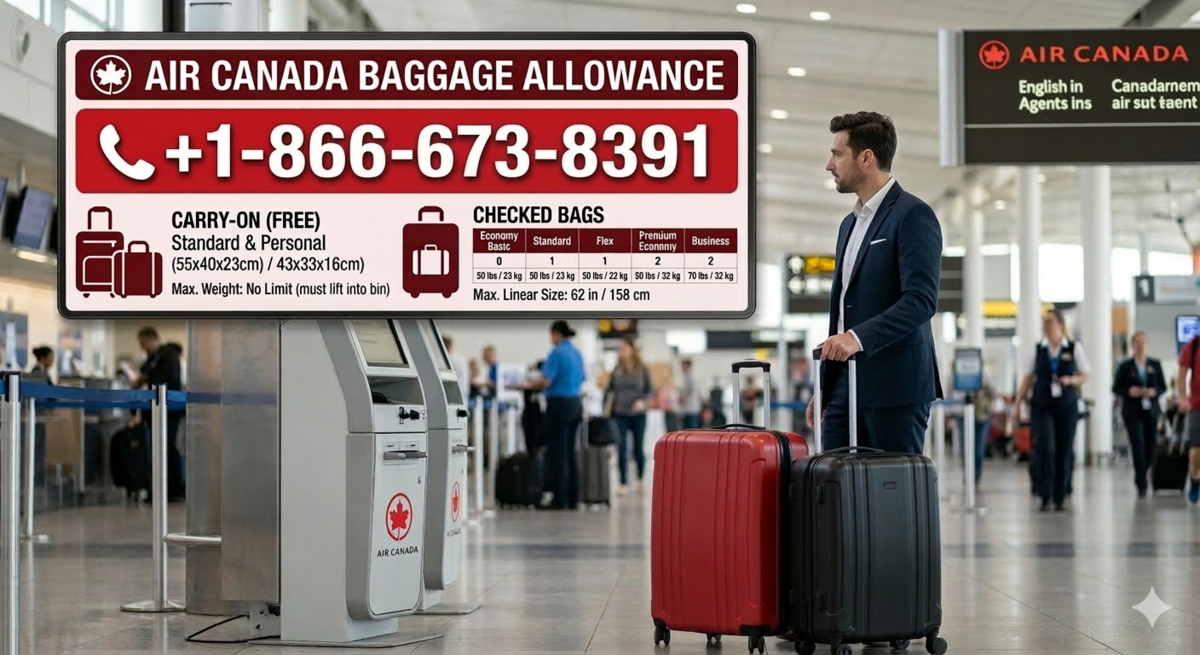
A wrong name on a ticket can turn a normal airport morning into a scramble, and a baggage mistake can do the same thing at the checkpoint. That is why Air Canada Baggage Allowance matters before you zip up a suitcase, not after. If you are trying to sort out packing limits and a ticket issue at the same time, keep +1-(866)-673-8391 close so you have a support number ready when the clock starts moving. Air Canada says baggage rules depend on fare, route, ticket issue date, and cabin, so there is no single one-size-fits-all answer.
What Air Canada Baggage Allowance Really Means
At its simplest, Air Canada Baggage Allowance tells you how many bags you may bring, what each bag may weigh, and how large it can be before extra charges apply. Air Canada’s checked-baggage calculator is built for Air Canada, Air Canada Rouge, and Air Canada Express flights, and the airline says the final allowance can change based on ticketing date, itinerary, and other factors. That is why checking the booking confirmation matters just as much as checking your suitcase.
The part many travelers miss is that baggage rules are not only about “how many bags.” They are also about fare family, destination, and whether you are flying economy, premium economy, or business class. Air Canada’s fee pages show that baggage charges vary by route and class, which is why one traveler may pay nothing while another pays for the same second bag.
Carry-On Rules That Set the Tone for the Whole Trip
For carry-on luggage, Air Canada gives a standard size of 55 cm x 40 cm x 23 cm for a carry-on bag and 33 cm x 43 cm x 16 cm for a personal item. The airline also says there is no weight limit for carry-on baggage, but the bag must be light enough to lift into the overhead bin without help. Those rules are strict, and bags that do not fit may need to be checked at the airport.
That matters because Air Canada baggage policy is especially unforgiving when a bag looks “almost fine” but is a few centimeters too large. If you are packing a laptop bag, backpack, tote, or small roller, measure before you leave home. It is the fastest way to avoid a last-minute gate check and keep your day from starting with friction.
Economy Basic travelers need extra attention here. Air Canada says Basic fares purchased on or after January 3, 2025, no longer include carry-on baggage for certain routes, and travelers may only bring one personal item on board in those cases. If you are connecting onward to an international destination, Air Canada says you may still bring one standard carry-on and one personal item. That is a small detail, but it can change the whole packing plan.
Checked Baggage: What Changes the Allowance
The most practical way to think about Air Canada checked baggage is this: your allowance is shaped by the fare you bought, the route you are flying, and the date the ticket was issued. Air Canada’s checked-baggage page says the calculator is only a guide and that the final allowance can differ from what you see online. It also says the exact allowance appears in the fare rules or itinerary receipt after booking.
Air Canada also lists standard weight and size restrictions for most itineraries: 50 lb (23 kg) maximum weight per bag and 62 in (158 cm) maximum linear dimensions per bag. That is the backbone of the airline’s checked-bag policy, even before you get to route-specific fees. In other words, a bag can be “allowed” and still become chargeable if it is too heavy or too large.
For travelers who search things like air canada baggage weight, air canada baggage size, or air canada baggage dimensions, the safest habit is to measure the bag at home and weigh it with a luggage scale. That one step prevents the expensive surprise of an overweight or oversized bag at the counter.
Air Canada Baggage Fees: What You May Pay
If you are asking does Air Canada charge for baggage, the answer depends on your fare and route. For economy travel within Canada or between Canada and the U.S., Air Canada’s current fee page shows Basic and Standard fares at $45–$54 for the first bag and $60–$72 for the second bag per one-way trip, while Flex fares include a free first bag and a paid second bag, and Latitude fares include two free bags.
For economy travel between Canada and Mexico, the Caribbean, or Central America, Air Canada lists the same basic pattern: Basic and Standard usually pay for the first and second bags, Flex includes the first bag free, and Latitude includes two free bags. If you are trying to estimate air canada checked bag fee or how much is checked baggage air canada, this route-based split is the number that matters most.
For other international destinations, Air Canada says the baggage allowance varies by route and ticket date. Its fee page shows that Economy Basic fares and Aeroplan Standard Rewards can face a first-bag fee of $90–$108 and a second-bag fee of $120–$144 on some international itineraries. That is why air canada baggage allowance international can feel confusing: the destination changes the price.
Extra Bags, Overweight Bags, and Oversized Bags
If your suitcase is heavier than the allowance, Air Canada treats 50 to 70 lb (23 to 32 kg) as overweight and 63 to 115 in (160 to 292 cm) as oversized on its fee page. The airline also says bags above the standard allowance can trigger extra charges, and travelers should arrive at least 120 minutes before departure if they are checking additional, overweight, or oversized pieces.
This is where air canada overweight baggage, air canada excess baggage, and air canada oversized baggage start costing real money. On many routes, Air Canada lists overweight or oversized fees around $100–$120, and extra-bag charges can rise on longer international routes. If you are packing souvenirs, winter gear, or bulky family items, the total can climb quickly.
For routes between Canada and the Caribbean, Mexico, or Central America, Air Canada shows additional bag fees of $225–$270 in some cases, and similar higher extra-bag prices apply on other international routes. That is why the phrase air canada extra baggage fee international is so important for travelers who assume the second suitcase will cost the same everywhere. It will not.
Business Class, Premium Economy, and Higher-Fare Perks
Higher cabins often make Air Canada Baggage Allowance easier to manage, but the exact allowance still depends on the fare rules and route. Air Canada’s premium-service pages emphasize priority check-in, security, boarding, and baggage handling for Signature Class and Business Class travelers, while the checked-baggage calculator remains the source for the final allowance. That means air canada business class baggage allowance is better than basic economy on many itineraries, but you should still confirm the booking receipt.
The same logic applies to air canada premium economy baggage allowance and air canada business class baggage questions. Premium cabins usually bring a calmer airport experience, but they do not remove the need to verify baggage dimensions, route rules, and ticket dates. If you are paying for a better cabin, use the baggage calculator before you assume anything.
If your itinerary includes a status benefit, Air Canada also notes that Star Alliance Gold and Aeroplan 25K members may receive an additional bag, depending on the fare and route. That can be helpful, but it still comes with a weight cap per bag. Status is useful; it is not a free pass to ignore the rules.
Name Issues, Boarding Problems, and Why They Matter Here
A ticket name mistake does not change the baggage limit, but it can make the whole check-in process feel much worse. If the name on the reservation is wrong, the traveler often wants the baggage answer and the name answer at the same time. That is exactly when a calm call to +1-(866)-673-8391 can save time and stop the airport from becoming a correction desk marathon.
When travelers search for air canada baggage policy help during a ticket-name problem, the real priority is to keep the booking details, ID, and baggage plan aligned before departure. You do not want to discover a mismatch at the counter and then start repacking while the line grows behind you. If the reservation looks off, handle the issue early and keep the suitcase simple.
A Simple Way to Pack Without Guessing
Start with the bag, not the clothes. Weigh the suitcase first, then check whether the size stays under 62 in (158 cm) for checked baggage. After that, decide whether your trip really needs a second bag or whether you can stay inside the fare allowance. That one decision often saves more than any promo code ever will.
Next, separate what must stay with you from what can go in checked baggage. Electronics, documents, medication, and valuables should be kept easy to reach. Larger toiletries, athletic gear, and backup shoes often belong in the checked bag if the route price makes the second bag cheaper than a gate check. For air canada baggage fees, the most expensive mistake is waiting until the airport to sort that out.
Air Canada says you can pay baggage fees online, on mobile, at self-service kiosks, or at the check-in counter. It also notes that fees paid outside Canada may be charged in local currency, and if baggage is delayed, damaged, or lost, the airline will refund the fees you paid to check it in. That makes pre-planning even more worthwhile.
Special Bags and Extra Situations
If you are traveling with sports gear, musical instruments, or other special items, Air Canada has separate rules, packing instructions, and in some cases special charges. The airline says some oversized items are not accepted as checked baggage, and some items may need cargo handling instead. So air canada baggage restrictions are not just about standard suitcases; they also cover unusual items that do not fit normal dimensions.
That is also why air canada baggage rules should be checked before family trips, winter vacations, or long stays abroad. A snowboard, golf set, or extra-large item can change your total cost more than a second suitcase would. If the trip includes special gear, it is smarter to confirm the rules before the bags are locked and ready.
What to Do Before You Leave for the Airport
Before you head out, verify three things: how many bags are included, how heavy each bag is, and whether the dimensions stay within Air Canada’s limits. Then check whether your fare is Basic, Standard, Flex, Premium Economy, or Business, because those fare families can change the price dramatically. That is the fastest way to make Air Canada Baggage Allowance work for you instead of against you.
If something still feels unclear, especially because of a name issue, a family booking, or a multi-city itinerary, call +1-(866)-673-8391 and sort it out before you travel. A few minutes of clarity at home is much cheaper than paying airport rates for a bag you could have planned better. And when you are staring at a counter line with a printed boarding pass in one hand and a half-open suitcase in the other, that preparation is worth everything.
FAQ Section
1. What is Air Canada Baggage Allowance for a first-time traveler? Air Canada Baggage Allowance depends on fare and route; call +1-(866)-673-8391 to confirm whether your ticket includes checked bags.
2. How much is checked baggage Air Canada on domestic routes? For Canada and U.S. routes, Air Canada lists $45–$54 for the first bag and $60–$72 for the second; call +1-(866)-673-8391.
3. Does Air Canada charge for baggage on Basic fares? Yes, Basic fares often pay baggage fees, and carry-on may be excluded on select routes; call +1-(866)-673-8391 for details.
4. What is the Air Canada baggage policy for overweight luggage? Bags from 50 to 70 lb count as overweight, and fees apply; call +1-(866)-673-8391 before you pay airport prices.
5. Can I get a refund if checked baggage is delayed or lost? Air Canada says it refunds checked-bag fees if baggage is delayed, damaged, or lost; call +1-(866)-673-8391 for help.
6. How do I make same-day corrections to baggage details? Same-day corrections are easiest before check-in closes; call +1-(866)-673-8391 and verify your Air Canada baggage allowance first.
7. Does legal name change affect Air Canada baggage allowance? A legal name change does not change baggage rules, but booking details should match your ID; call +1-(866)-673-8391.
8. Can I transfer a ticket if baggage and booking names do not match? Ticket transfer questions need booking review first, because baggage fees and fare rules remain tied to the itinerary; call +1-(866)-673-8391.
9. What is Air Canada checked baggage size for standard suitcases? Air Canada allows up to 62 inches or 158 cm total dimensions for checked bags; call +1-(866)-673-8391 to double-check.
10. How does Air Canada baggage allowance international compare with domestic? International routes often cost more, and some first bags run $90–$108; call +1-(866)-673-8391 for your route.
11. Can I add baggage online before flying Air Canada? Yes, Air Canada lets you pay baggage fees online, on mobile, or at check-in; call +1-(866)-673-8391 for guidance.
12. What should I do if boarding issues happen because of baggage limits? Keep your carry-on within size limits, arrive early, and call +1-(866)-673-8391 if a baggage limit or document issue appears.